
Travel Health
Digital Health Passports for the 2026 World Cup Final: Why You Need Your Medical Vault Abroad
By The Arxova Team · July 14, 2026 · 10 min read
More than 500,000 Hajj pilgrims used verified digital health credentials across 2024 and 2025, proving that a digital health passport can work at the scale of the world's biggest gatherings, and the 2026 World Cup Final is about to test that same idea on an even bigger stage. When millions of fans cross borders for the tournament, the question isn't whether you'll need your medical records. It's whether you'll be able to reach them when it matters.
Key Takeaways
- What it is: A digital health passport is an encrypted, portable record of your vaccinations, medications, and medical history that travels with you, not a paper folder you hope customs doesn't lose.
- Why now: Amended International Health Regulations required countries to recognize digital vaccination certificates as of September 19, 2025, making this the first World Cup Final under the new rules.
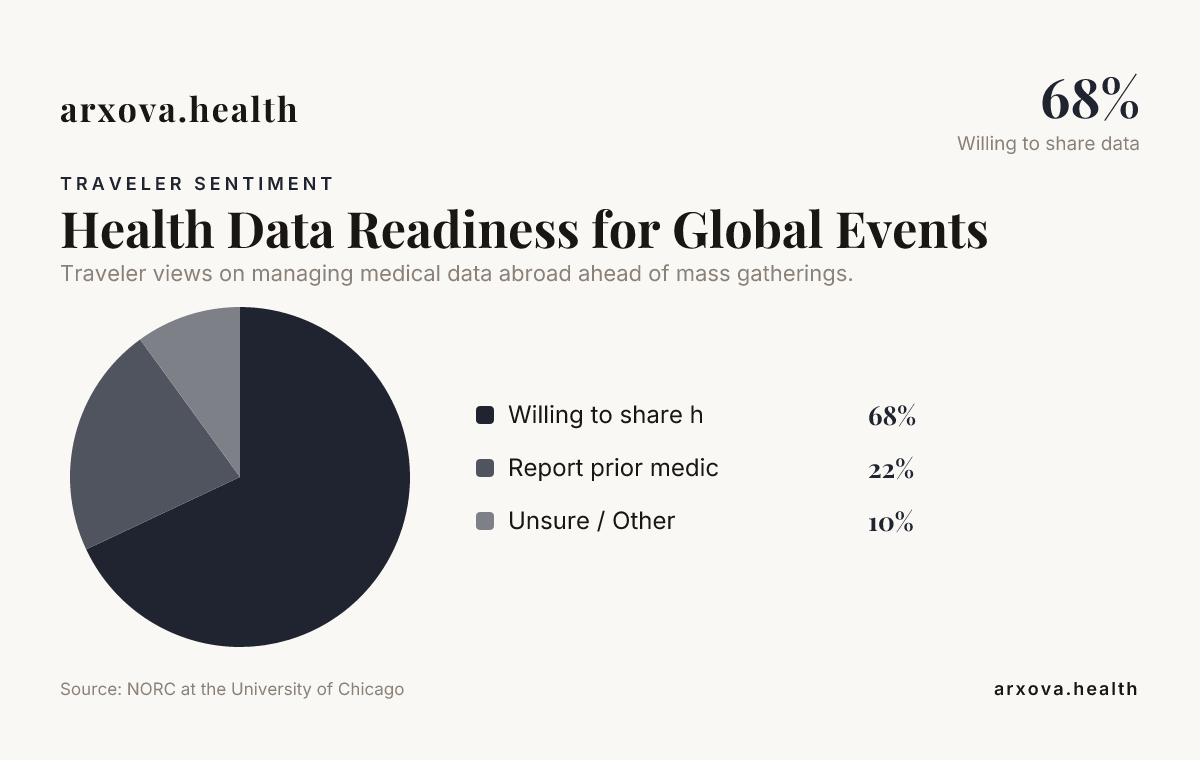
- The gap: Only 22 percent of U.S. adults currently use patient-facing digital health tools, meaning most travelers heading to FIFA World Cup 2026 matches are still relying on scattered paper or portals.
- The upside: 68 percent of people who do use digital health tools report a better overall healthcare experience, a meaningful edge if you need care in an unfamiliar country.
- The timeline: Health authorities recommend confirming your vaccination status at least two weeks before travel so your immunity is fully recorded before kickoff.
- The solution: A patient-owned health vault puts your records, labs, and medications in one encrypted place you control from your phone, wherever you land.
- How to check readiness: Review your consent and access settings before you fly so you know exactly who can see your data and for how long.
Note: This article is for general information only and is not medical or travel-health advice. Confirm vaccination and entry requirements with official sources and your own clinician before you travel.
Why the 2026 World Cup Final Changes Everything About Medical Records Abroad
The 2026 tournament is unlike any World Cup before it. Matches are spread across the United States, Mexico, and Canada, which means fans, players, and staff are moving between three different healthcare systems, three sets of pharmacy rules, and three different ways doctors document care.
If you're flying into the World Cup Final 2026 host city with a cardiac condition, a chronic illness, or even just a list of prescriptions, that fragmentation is not a minor inconvenience. It's a risk.
Your health has been everywhere but with you. Bring it home, even when home is a stadium three time zones away.
What Is a Digital Health Passport, and Why FIFA World Cup 2026 Travelers Need One
A digital health passport is not a single document. It's a living, encrypted record of who you are medically: your allergies, your medications, your last EKG, your vaccination history, all in one place that updates as your care changes.
For anyone attending FIFA World Cup 2026 matches, that matters because emergency rooms abroad can't call your home clinic and wait on hold for records.
They need what you know about your own body, instantly, in a format their systems can actually read.
This is where international medical records access stops being a policy phrase and starts being personal. It's the difference between a doctor in Toronto or Mexico City treating you with full context, or treating you blind.
The Problem With Paper Records and Scattered Portals at the World Cup Final
Most people's medical history lives in five or six different places. A pediatrician's portal from years ago. A cardiologist's system that requires a phone call. A pharmacy app. A folder of discharge papers nobody scanned.
None of it travels with you.
Arxova was created by a registered nurse who watched, every shift, patients locked out of their own records when it mattered most. That's not a hypothetical for anyone who's worked a cardiac floor. It's Tuesday.
Not scattered across portals you can never quite reach, or locked in a system you have to call to get into. When you're standing in a foreign pharmacy trying to explain a blood thinner dosage, that gap becomes very real, very fast.
Did You Know?
Amended International Health Regulations required every country to recognize digital International Certificates of Vaccination by September 19, 2025, making this the first World Cup Final held under the new global standard.
Source: World Health Organization
How Arxova Works as Your Medical Vault Abroad
Your information is encrypted and stored in a vault that answers to you, not to a hospital system, not to an insurer, not to a portal that expires your login every 90 days.
Here, it's in your hands, calm, clear, and ready the moment you need it.
Arxova pulls together your lab results, your medication list, your wearable data, and your medical history into one encrypted app. Its security controls were independently examined under SOC 2® Type 1, so the protection travels with the data.
You decide who has access, for what, and for how long, and you can revoke it anytime. No calling a records department from a hotel lobby in Guadalajara at midnight.
The first time everything you've ever been told about your body is finally on one screen, you feel it, and it's yours.
Wearables Don't Stop Traveling Either
Your heart rate, sleep, and recovery data don't pause when you land for the final. If anything, tournament travel, heat, crowds, and long walks between stadiums make that data more useful, not less.
Arxova connects directly with the devices most fans already wear, so your baseline vitals stay part of your record the whole trip.



ARIA: A Health Intelligence Assistant That Travels With You
ARIA is Arxova's non-diagnostic health intelligence engine, and it reads your own data, not a generic symptom checker.
Ask it what your last cardiologist visit noted, or whether your blood pressure trend is normal for someone standing in 95-degree heat at a stadium, and it answers in plain English, grounded in your actual records.
That's the difference between guessing and knowing when you're far from your regular doctor. ARIA doesn't diagnose. It translates the medical-ese so you understand what's already in your file.
What PAHO and CDC Recommend Before You Travel to the 2026 World Cup Final
Health authorities are treating this tournament as a serious cross-border event, not a routine travel season. The Pan American Health Organization recommends checking and completing your vaccination status at least two weeks before departure, so full immunity is documented before you're standing in a crowd of 80,000 people.
The CDC echoes similar guidance for travelers heading into large-scale international gatherings. And New Jersey has already built a digital public health hub specifically for the 2026 FIFA World Cup, which tells you how seriously host regions are taking digital health readiness.
Two weeks isn't a random number. It's how long it takes most vaccines to reach full effectiveness, and it's exactly the kind of detail that gets lost when your records live in three different systems.
Security: Why Your Medical Vault Needs to Answer to You
Not to a hospital network. Not to a third-party app that got acquired last year and quietly changed its privacy policy.
Arxova's security architecture encrypts records before they leave for storage, with a growing set of them encrypted with your own wallet's key, which require that key or an authorized decryption path. Storage is permanent through Arweave rather than a server somewhere you'll never see, and key access and consent events are recorded as tamper-evident receipts on the Solana blockchain, so when your data is accessed, shared, or deleted, there's a record of it.
That matters more abroad than at home. When you're outside your own country's data protection laws, you want a system built so your records aren't sitting in one company's database waiting on that company's judgment.
Did You Know?
82 percent of people reuse passwords across accounts, which means the same login habits protecting your email may also be guarding your medical history while you travel abroad.
Source: IBM Security
Pack your medical history before you pack your jersey.
Download the Arxova app and subscribe to The Pulse to build your digital health passport before kickoff.
Travel Health Data Management: Getting Your Vault Ready Before You Fly
Setting up your medical vault before the tournament takes less time than printing your boarding pass. Here's the order that actually works.
- Connect your sources. Link your electronic health records, pharmacy, and wearables into one place.
- Review and confirm. Check vaccination records, current prescriptions, and any recent labs for accuracy.
- Set your consent rules. Decide in advance who can view what if you need urgent care abroad, through the consent controls.
- Download offline access. Make sure key documents are viewable even without reliable stadium wifi.
- Pack the basics too. Broad-spectrum SPF 30 sunscreen and hydration matter just as much as your digital documents when you're standing in a sun-baked stadium for hours.
You're not doing this alone. Arxova was built by someone who has stood on your side of it, watching patients scramble for records in moments they least had the time.
Own Your Data, Even When You're Contributing to Research
Some travelers want their health information to do more than sit in a vault. If you choose to, you can opt in to research matching, which checks your clinical records against study criteria. It is entirely opt-in and you can stop it at any time; a study team sees who you are only after you sign that study’s consent. Participation runs on IRB-approved consent. If you take part, any compensation a study offers is between you and the study; Arxova does not sell health data and does not pay participants.
That's what patient-owned really means in practice. You're not signing away your records to get care. You're deciding, line by line, what leaves the vault and what stays.
Learn more about how consented research works through Arxova's research program, built on the same consent infrastructure that protects your everyday records.
What Your Digital Health Passport Actually Costs
Arxova is free — no subscription, no card required.
That means the tool that keeps your medical records unified and protected across three countries costs you nothing.
Arxova includes full access to your encrypted health vault, ARIA insights, and wearable integrations at no cost. You can review when HIPAA applies to your information on Arxova's How HIPAA applies to Arxova page before you sign up.
Getting Your Vault Before Kickoff
The app is available now for both major platforms, and setup takes minutes, not the hour you'd spend on hold with a records department.
For questions before your trip, the support center covers everything from wearable connections to consent settings.
Conclusion: Your Medical Vault Abroad Is the Real Preparation for the 2026 World Cup Final
Packing sunscreen and a jersey is easy. Packing your medical history took planning, until now.
The 2026 World Cup Final will bring millions of people across borders where healthcare systems, languages, and records don't line up neatly. A digital health passport, backed by a real medical vault, closes that gap before it becomes an emergency.
Arxova is where your health becomes yours again, whether you're watching the final from the stands or managing a chronic condition three time zones from home.
Build your digital health passport
Download the Arxova app on iOS or Android, or get started instantly in your browser. Then subscribe to The Pulse for practical reads on owning your health data, at home and abroad.
Subscribe to The Pulse
Frequently Asked Questions
Do I need a digital health passport to attend the 2026 World Cup Final?
It's not a mandatory ticket requirement, but health authorities strongly recommend it given the amended International Health Regulations now requiring countries to recognize digital vaccination certificates. Having a digital health passport ready before the World Cup Final 2026 means faster, safer care if you need it abroad.
What's the difference between a digital health passport and a regular medical record?
A regular medical record usually sits in one clinic's portal and doesn't move with you. A digital health passport is a portable, encrypted version of your full history that you control and can share on your terms, wherever you travel for FIFA World Cup 2026.
How far in advance should I prepare my medical vault before traveling?
Health organizations recommend confirming vaccinations and finalizing documentation at least two weeks before departure. That gives your immunity time to reach full effectiveness and gives you time to review your international medical records access settings.
Is a digital medical vault safe to use abroad?
Yes, provided it uses real encryption standards, has had its security controls independently examined, and does not leave your records sitting readable in one company's database. Arxova encrypts records before they leave for storage, with a growing set of them encrypted with your own wallet's key, which require that key or an authorized decryption path to open, so your data stays protected even when you're outside your home country's data protection laws.
Can doctors abroad actually access my digital health passport?
Yes, if you grant temporary, revocable access through your consent settings, treating physicians can view exactly the records you choose to share, no more and no less. This is the core benefit for travel health data management: you decide who sees what, for how long, and you can revoke access the moment you're home.
Does a digital health passport work if I lose phone signal at the stadium?
Most platforms, including Arxova, allow offline access to key documents once they're downloaded ahead of time. It's worth confirming critical records, like your vaccination history and medication list, are saved locally before you head into a crowd of 80,000 people.
Is a medical vault app worth it just for one trip to the World Cup Final?
Arxova is free, so there's no cost to weigh for a single trip. Given that emergency care abroad without accessible records can cost far more in time, stress, and money, having your records unified and ready is worth it even for one trip.
This article is for general educational purposes only and is not medical or travel-health advice. Confirm vaccination and entry requirements with official sources and your own clinician. Statistics are drawn from third-party research. Arxova is a health data platform; participation in research is optional, opt-in, and revocable. Arxova does not sell health data and does not pay participants. Clinics and research institutions pay Arxova for the matching infrastructure. Any compensation a study offers is between the participant and the study. Arxova is not a data broker.