
Wearables
Heart Rate Recovery After Exercise: What Your Numbers Actually Mean
By The Arxova Team · July 16, 2026 · 9 min read
Here's a number that should make you look twice at your wearable: someone whose heart rate drops by 54 beats per minute in the first sixty seconds after exercise sits in the top 1% of the population, while someone dropping just 21 beats is sitting in the bottom quartile. That's not a rounding error. That's the difference between a cardiovascular system that's thriving and one that's quietly asking for attention, and heart rate recovery after exercise is the single number that tells you which one you are.

Key Takeaways
| Question | Quick Answer |
|---|---|
| What counts as normal heart rate recovery after exercise? | A drop of 12 beats or more in the first minute after you stop exercising. |
| What's considered elite recovery? | A drop of 54 bpm or higher puts you in the top 1% of measured adults. |
| How accurate are wrist wearables at tracking this? | Devices like Apple Watch land within 5 bpm of clinical accuracy 89-98% of the time. |
| Do all recovery scores use the same math? | No. Only 2 of the 12 major commercial recovery scores have published, peer-reviewed validation. |
| Where can I see my own heart rate recovery data in one place? | Our Cardio Recovery feature pulls it straight from your wearable into your health record. |
| Does age change what's "normal"? | Yes. A 65+ woman recovering 25 bpm is in her 90th percentile, while a man the same age hits that mark at 19 bpm. |
| Is HRV the same thing as heart rate recovery? | No, but they're related. 86% of recovery-tracking devices lean on heart rate variability, while HRR is a separate, single-point measurement. |
Note: This article is for general information only and is not medical advice. Heart rate recovery is a signal, not a diagnosis. Speak with your own clinician about decisions related to your care.
What Is Heart Rate Recovery After Exercise, and Why It's Worth Watching
Heart rate recovery after exercise is exactly what it sounds like. It's how many beats per minute your pulse falls in the first sixty seconds after you stop moving.
That drop isn't random. It's your parasympathetic nervous system, the "rest and digest" side of you, stepping back in to slow things down.
A fast, steep drop means that system is working well. A slow, shallow one is a signal, not a diagnosis, but a signal worth paying attention to.
We've watched this number get treated like a footnote on fitness apps for years. But heart rate recovery after exercise has quietly become one of the more reliable predictors of cardiovascular fitness that regular people can measure at home, with a watch on their wrist and no lab visit required.
How to Measure Your Heart Rate Recovery After Exercise
The method is simple enough to do tonight.
- Get your heart rate up to a solid working pace, running, cycling, rowing, whatever gets you breathing hard.
- Stop moving completely and start a timer the second you do.
- Note your heart rate at the moment you stop.
- Check it again exactly 60 seconds later.
- Subtract the second number from the first. That's your heart rate recovery after exercise.
Most modern wearables automate this now, which is part of why the metric has moved from cardiology labs into everyday workout summaries. Apple Watch, Whoop, Oura, and Garmin all capture some version of it, though they don't always label it the same way or trust it equally.
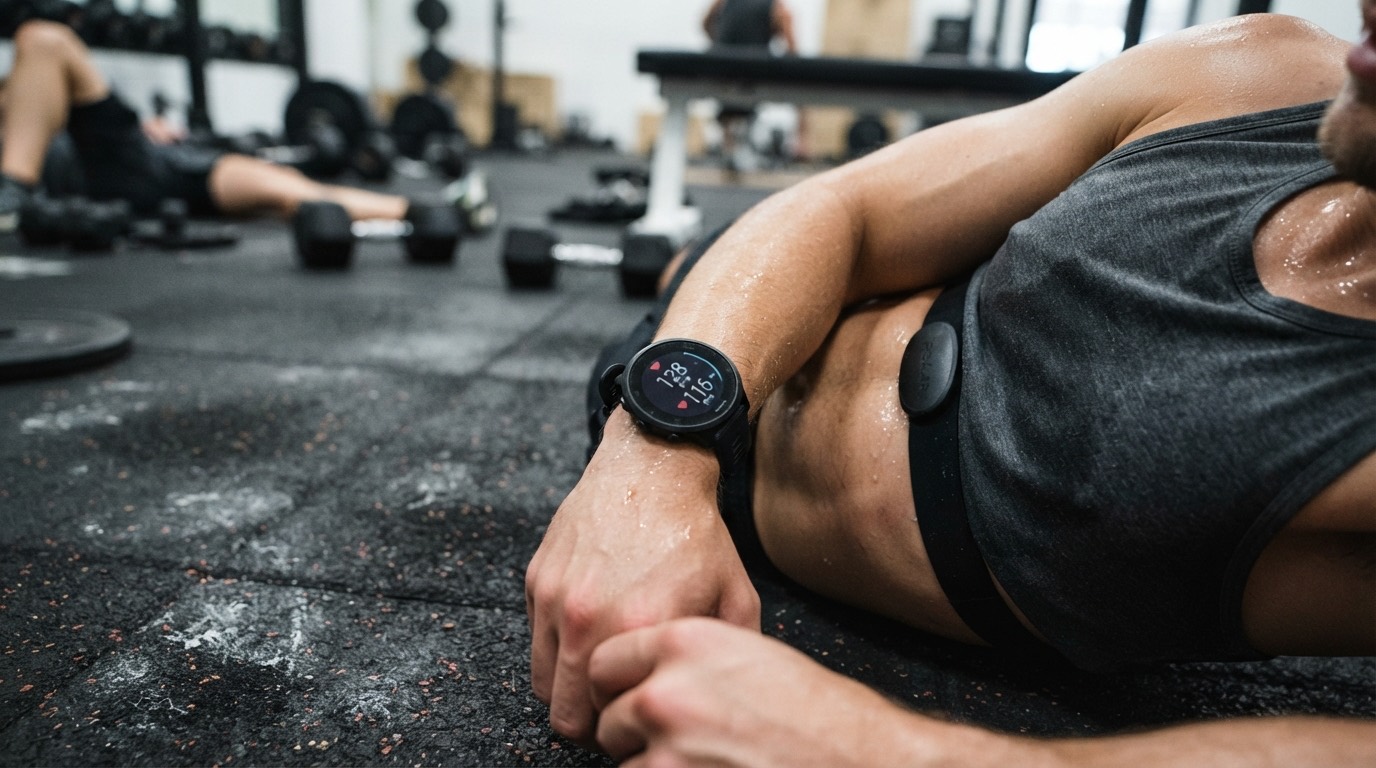
What a Normal Heart Rate Recovery After Exercise Looks Like by Age and Group
"Normal" isn't one number. It shifts with age, sex, and baseline fitness, which is exactly why a single figure on a screen can feel meaningless without context.
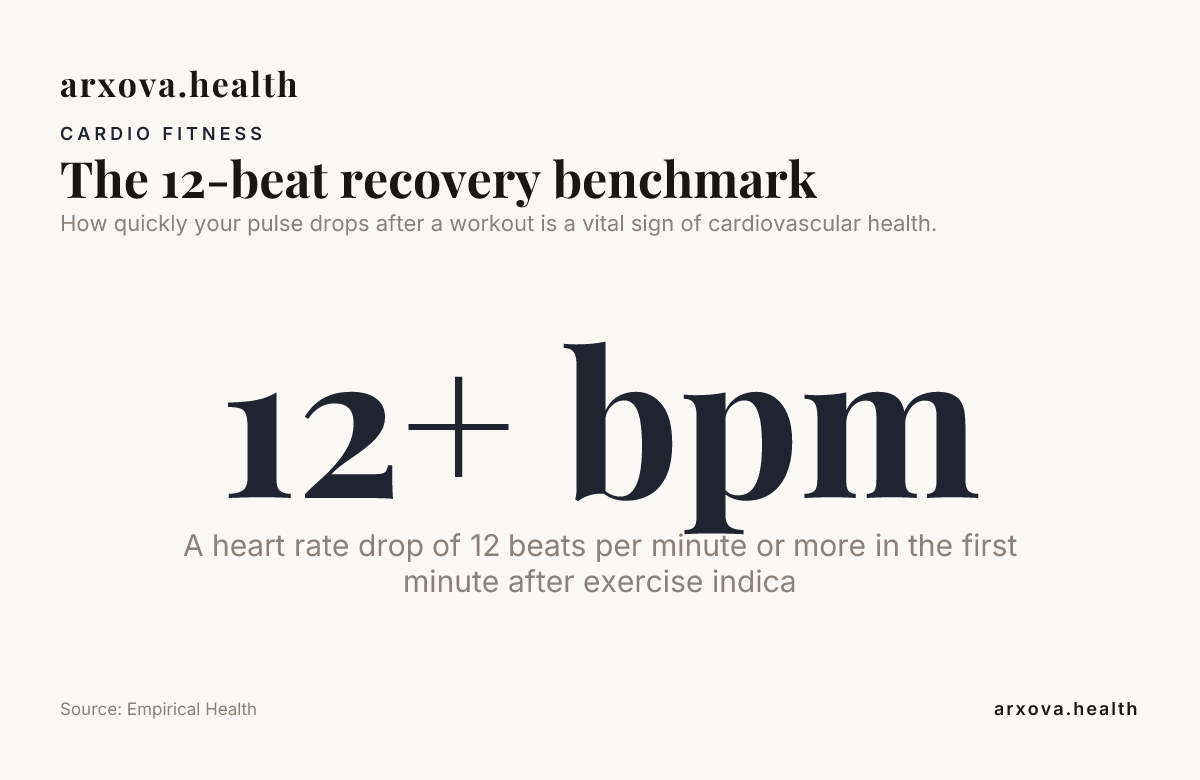
- General baseline: A drop of 12 beats or more in the first minute is the widely used threshold for healthy recovery.
- Under 35: A recovery of 43 bpm puts you in the top 10% of your age group.
- 65 and older, women: 25 bpm represents the 90th percentile.
- 65 and older, men: 19 bpm hits that same 90th percentile mark.
- Elite range: 54 bpm or higher is top 1% territory, regardless of age.
- Below average: 21 bpm sits in the bottom quartile, a sign your cardiovascular system may need more conditioning work.
Notice how wide that range is. A 65-year-old woman and a 25-year-old man aren't being measured against the same yardstick, and they shouldn't be. This is precisely the kind of context that turns a raw number into something you can actually act on.
Did You Know?
A drop of 12 beats or more in the first minute after exercise is the baseline used to call heart rate recovery "normal."
Source: Empirical Health
Best Wearables for Tracking Heart Rate Recovery After Exercise
Not every device measures this the same way, and not every device is transparent about how it gets there. Here's how the major players stack up.
Apple Watch: Best for Everyday Accuracy
Apple Watch's optical heart rate sensor lands within 5 bpm of true readings somewhere between 89% and 98% of the time, depending on the study.
That's close enough to trust for daily tracking, and it's why Apple Watch HRR data shows up so often in workout summaries people actually check.
Whoop, Oura, and Garmin: Best for Recovery Scoring
These platforms bundle heart rate recovery after exercise into a broader "recovery score," usually leaning heavily on heart rate variability alongside it. In fact, 86% of recovery-tracking devices on the market use HRV as their primary signal, with heart rate recovery folded in as a supporting data point rather than the headline number.
That's useful for a daily readiness snapshot, but it also means the raw HRR number can get buried under a proprietary algorithm you can't see inside.
Why Recovery Scores Aren't All Built the Same
Here's the part most people never hear. Of the twelve major commercial recovery scores on the market, only 2 have any published, peer-reviewed validation behind their formulas.
The rest are proprietary. You get a number, a color, maybe a percentage, but you don't get to see the math, and you can't independently confirm it means what the app claims it means.
That's not a reason to distrust every wearable you own. It's a reason to want your raw heart rate recovery after exercise data sitting somewhere you control, not locked inside one company's black box, so you can compare it against your own history instead of someone else's algorithm.
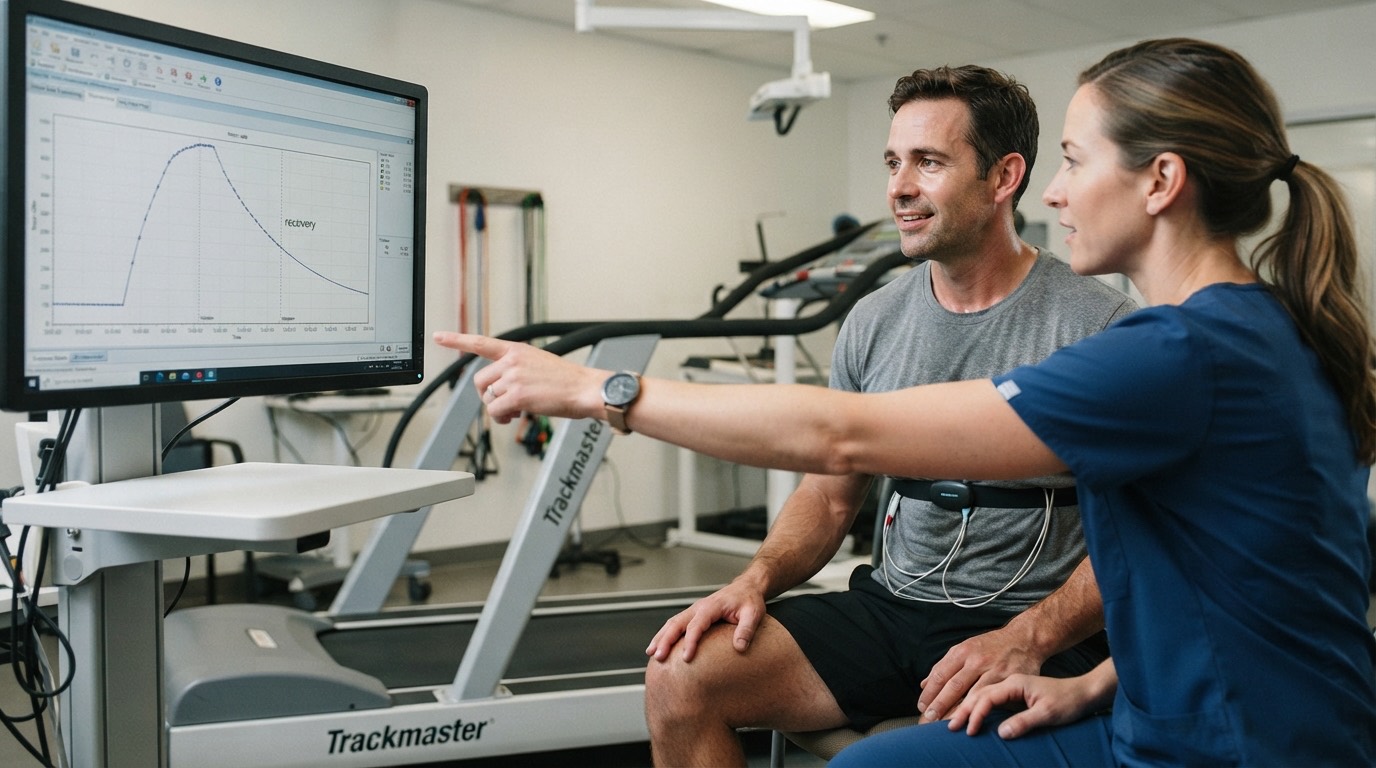
How Arxova's Cardio Recovery Feature Fits Into the Picture
Arxova was created by a registered nurse who watched, every shift, patients locked out of their own records when it mattered most. Heart data was no exception. It lived in one app, your labs lived in a portal, and nobody was connecting the two.
Our Cardio Recovery feature pulls your heart rate recovery after exercise, including Apple Watch HRR, directly into your workout summaries inside your Arxova vault. It sits next to your labs, your medications, and your provider notes instead of floating alone in a fitness app that's disconnected from the rest of your health picture.
ARIA, our AI health assistant, helps you understand that data and gives you plain-language context. Not "your score is 32," but what a 32 actually means for someone your age, with your history, on your terms.
Your health has been everywhere but with you. Bring it home.
That's the whole idea behind our Wearable Intelligence features, connecting sleep, resting heart rate, cardio recovery, and lab results into one place that finally talks to itself.
Did You Know?
Apple Watch's heart rate sensor lands within 5 bpm of clinical accuracy 89-98% of the time.
Source: Empirical Health
Getting Your Heart Rate Recovery Data Into One Place
Connecting your data starts simple. You link your providers, your pharmacy, your labs, and your wearable, and everything encrypts and lands in one vault. That's the full process laid out on our how it works page, and it takes minutes, not weeks.
Your information is encrypted and stored in a vault that answers to you. Not scattered across portals you can never quite reach, or locked in a system you have to call to get into.
Here, it's in your hands, calm, clear, and ready the moment you need it. You decide who has access, for what, and for how long, and you can revoke it anytime.
You can also choose — entirely opt-in and revocable — to opt in to research matching, which checks your clinical records against studies run by institutions under IRB-approved consent. If you take part, any compensation a study offers is between you and the study. Arxova does not sell health data and does not pay participants. Wearable data, including heart rate recovery, is not used for research matching, and whether you take part at all is always your call.

See your own heart rate recovery next to the rest of your health.
Download the Arxova app and subscribe to The Pulse to bring your wearable, labs, and records into one vault.
Tips to Improve Your Heart Rate Recovery After Exercise
Heart rate recovery after exercise isn't fixed. It responds to training the same way your resting heart rate does.
- Build an aerobic base. Consistent moderate cardio, three to five times a week, is the single strongest lever for a faster recovery.
- Add interval work gradually. Intervals train your parasympathetic system to kick back in faster after effort.
- Sleep enough. Poor sleep blunts recovery the same way it blunts almost every other cardiovascular marker.
- Manage stress. Chronic stress keeps your sympathetic nervous system dominant, which slows the recovery curve.
- Track it consistently. One reading tells you little. A trend over weeks tells you everything.
Small, steady improvements here tend to show up before other fitness markers do, which is part of why heart rate recovery after exercise is such a useful early signal.
Who Should Pay Closer Attention to Their Numbers
Anyone can benefit from watching this metric, but a few groups should treat it as a priority.
| Group | Why It Matters |
|---|---|
| Returning to exercise after illness or injury | A slow heart rate recovery after exercise can flag deconditioning before it becomes obvious elsewhere. |
| Adults 65 and older | Age-adjusted benchmarks (19-25 bpm at the 90th percentile) make it easier to spot real decline versus normal aging. |
| People with cardiovascular risk factors | Slower recovery has been associated with higher cardiovascular risk in clinical research. |
| Endurance athletes | Tracking trends helps confirm training is producing real adaptation, not just fatigue. |
If you fall into any of these groups, having your heart rate recovery after exercise sitting inside your broader medical record, next to your history and your labs, matters more than having it live inside a single fitness app. That's what our patient-owned health vault was built for.
Conclusion
Heart rate recovery after exercise is one of the rare fitness numbers that's both easy to measure and genuinely meaningful. A 12-beat drop is the floor for "normal." A 54-beat drop puts you in rare company. And everything in between tells a story about how well your body bounces back.
We built Arxova because that story shouldn't live scattered across a fitness app, a portal, and a paper folder in a filing cabinet. It should live with you.
You're not doing this alone, Arxova was built by someone who has stood on your side of it. Download the app, connect your wearable, and watch your heart rate recovery after exercise become one more piece of a health record that's finally, actually yours.
Make your heart data yours
Download the Arxova app on iOS or Android, or get started instantly in your browser. Then subscribe to The Pulse for research-backed reads on wearables, recovery, and owning your health data.
Subscribe to The Pulse
Frequently Asked Questions
What is a good heart rate recovery after exercise?
A drop of 12 beats or more in the first minute after you stop exercising is considered normal, while 43 bpm or higher (under age 35) puts you in the top 10% of your age group. Anything above 54 bpm is elite, roughly top 1% territory.
What does slow heart rate recovery after exercise mean?
A slower recovery, closer to the 21 bpm bottom-quartile mark, often points to lower cardiovascular fitness or a parasympathetic nervous system that isn't kicking in efficiently. It's worth tracking over time rather than reacting to a single reading.
Is Apple Watch accurate for tracking heart rate recovery after exercise?
Yes, generally. Apple Watch's optical sensor lands within 5 bpm of clinical accuracy between 89% and 98% of the time, which is reliable enough for everyday tracking and trend spotting.
Is heart rate recovery the same as heart rate variability (HRV)?
No. Heart rate recovery after exercise measures how fast your pulse drops after activity, while HRV measures the variation between individual heartbeats at rest. Most recovery-tracking devices, about 86% of them, lean on HRV as their primary signal, with heart rate recovery playing a supporting role.
Can I trust my wearable's overall "recovery score"?
Use it as a helpful daily signal, but know that only 2 of the 12 major commercial recovery scores have published, peer-reviewed validation. The raw heart rate recovery after exercise number underneath it is usually more transparent and easier to verify yourself.
Does heart rate recovery after exercise change with age?
Yes, benchmarks shift significantly by age and sex. In the 65-and-older group, 25 bpm hits the 90th percentile for women while 19 bpm does the same for men, both notably lower than the under-35 benchmark of 43 bpm.
Is tracking heart rate recovery after exercise worth it in 2026?
Yes, especially now that wearables and apps make it effortless to capture automatically during every workout. Combined with the rest of your health record in one place, it becomes a genuinely useful early signal instead of just another number on a screen.
This article is for general educational purposes only and is not medical advice. Heart rate recovery is a signal, not a diagnosis; statistics are drawn from third-party research and vary by individual. Speak with your own clinician about decisions related to your care. Arxova is a health data platform; participation in research is optional, opt-in, and revocable. Arxova does not sell health data and does not pay participants. Clinics and research institutions pay Arxova for the matching infrastructure. Any compensation a study offers is between the participant and the study. Arxova is not a data broker.